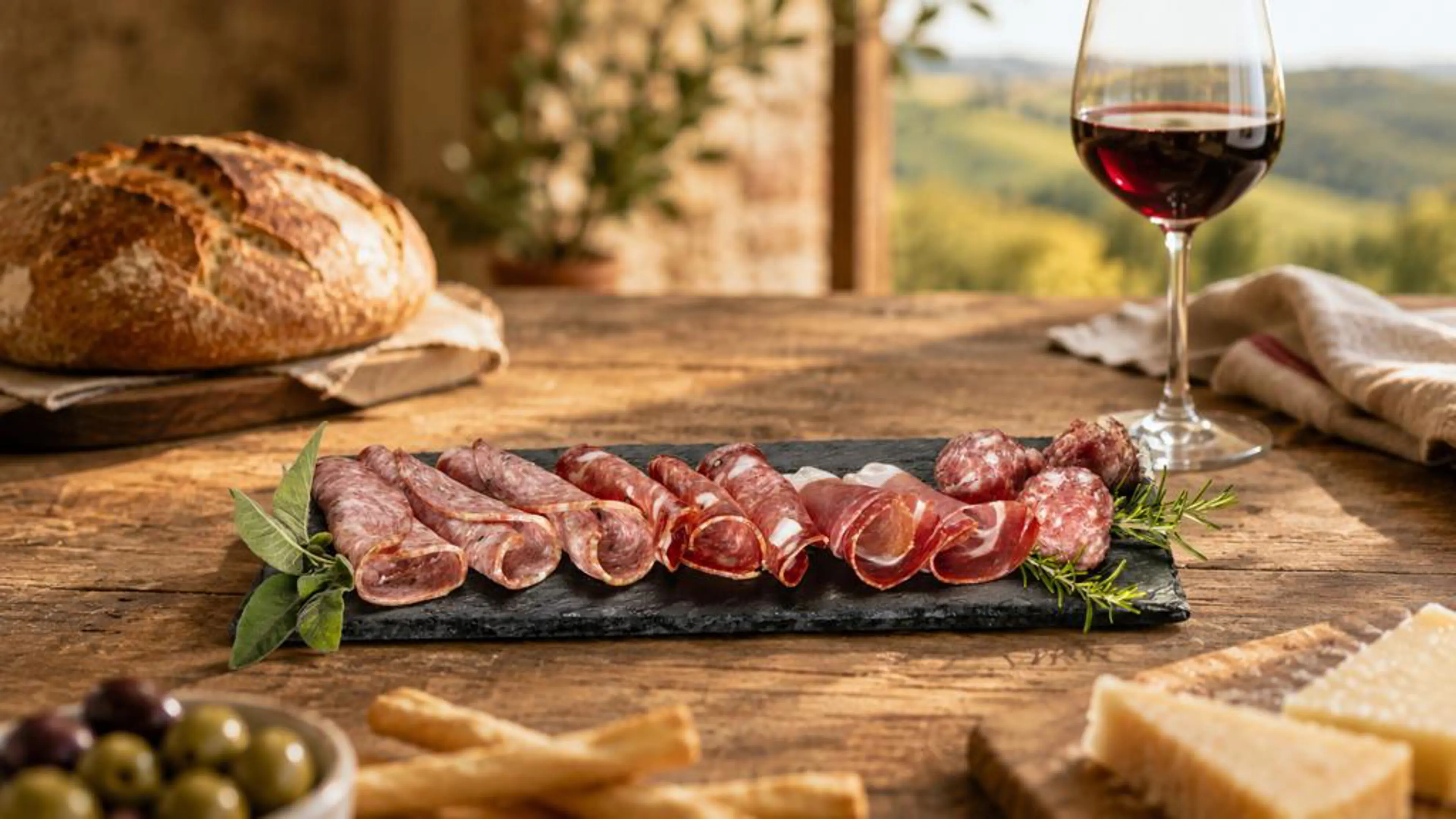
The cured meat board is one of those dishes that seem simple to prepare but that, to really turn out well, require care. It is not just a matter of putting together any cured meat and any cheese: there is thought behind the choice of ingredients, their proportions, and the order in which they are arranged.
In Tuscany, the tradition of the board is very old. Let’s see how to compose a board that respects the local tradition, which cured meats to choose, which pairings to use, and in what quantities.
A Tuscan board that works alternates at least three to four different types of cured meats, so as to offer a variety of flavors, textures, and intensities. The unwritten rule is: balanced contrasts. A delicate cured meat next to an intense one, a lean cured meat next to a fatty one, a classic cured meat next to a more distinctive one.
The cured meats you should not forget
Prosciutto crudo is the starting point. A good aged prosciutto opens the board with its sweetness and tenderness. It is the most "gentle" cured meat, the one that cleanses the palate before the bolder flavors.
Finocchiona cannot be missing. It is the Tuscan identity of the board: the aroma of fennel seeds is noticeable in the first bite and prepares the palate for the other cured meats. On a good Tuscan board, it is almost always present.
Tuscan salame completes the classic trio. Bold flavor, fine grind, visible cubes of fat. It is the counterpoint to prosciutto: where prosciutto is delicate, salame is flavorful; where prosciutto is soft, salame is compact.
The cured meats that make the difference
Beyond the three classics, a board that stands out from the others includes at least one or two less obvious cured meats. Tuscan guanciale - different from the Lazio version used in cooking - adds an aromatic note of cloves and garlic that surprises those who do not know it. Aged pancetta, sliced thin, brings the taste of pepper and savory meat. Aged spalla, with its very pronounced flavor and black pepper coating, is for those seeking intensity.
If you want a special touch, summer truffle salame is a cured meat worth having on the board - its aromatic truffle notes completely change the tone of a bite, and remind us that the Tuscan territory also has truffles among its excellences.
Cooked cured meats, often forgotten
A "true" Tuscan board is not made only of aged cured meats. The local tradition has some cooked cured meats that are often overlooked but add valuable variety: Tuscan mortadella (with or without pistachios), soprassata (a typical preparation with head and tongue, slowly cooked), pancetta cooked in lard (a specialty of the Montagna Pistoiese). You do not need to include them all - just one is enough to add a different texture and a different flavor to the board.
The recurring question: how many cured meats to put per guest. It depends on the role the board plays in the meal.
If the board is an appetizer
As an appetizer - that is, before a first course and a second course - the correct amount is between 60 and 80 grams of cured meats per person, considering the total of all the types present. A board for four people as an appetizer will therefore contain between 250 and 300 grams of cured meats in total, distributed across three to four types.
If the board is a main meal
If instead the board is the main dish - a casual dinner, a long aperitivo - the amount rises to 100-150 grams of cured meats per person. A board for four people as a meal will therefore contain between 400 and 600 grams of cured meats in total, with more variety (four to five types) to provide a richer tasting experience.
The variety rule
Better less of each cured meat but more variety, than lots of slices of just one type. A rich board is one that offers at least three to four different experiences. Consider that 15-20 grams per person of each individual cured meat is enough for everyone to taste it calmly.
Arrangement is not just aesthetic: it influences the order in which guests taste the cured meats and therefore the overall experience.
The most common rule is to arrange the cured meats from the most delicate to the most intense, moving clockwise or from one side to the other. Start with prosciutto crudo (the sweetest), move on to finocchiona (aromatic but delicate), then Tuscan salame (more flavorful), then the more intense cured meats (guanciale, spalla, summer truffle salame). Those who taste in order naturally build a crescendo of flavors.
The slices should be cut just before serving, as thin as possible for aged cured meats, a little thicker for cooked ones (otherwise they crumble). Place each cured meat on one side of the board, with a small space between one and the next, so that the flavors do not visually mix and guests can choose.
The bread
Tuscan bread - the classic unsalted one - is designed specifically to accompany cured meats. Its neutrality cleanses the palate and does not cover the flavors. If you cannot find it, a plain rustic bread is fine. Avoid bread with olives, seeds, or added grains: they introduce flavors that overlap with the cured meat. An alternative: simple schiacciata with olive oil, or plain Tuscan crostini.
The cheeses
Cheeses enrich the board but should not dominate it. Better one or two different cheeses than four or five. The best companions for Tuscan cured meats are local pecorinos: fresh Tuscan pecorino to accompany the more delicate cured meats (finocchiona, prosciutto), aged pecorino or pit-aged pecorino for the more intense ones (salame, guanciale). A piece of cow’s milk caciotta can also work if you want something milder.
Pickled vegetables and condiments
Vegetables in oil or vinegar add acidity and freshness, essential for balancing the fat in cured meats. The classics: borettane onions, mixed pickles, artichoke hearts, giardiniera. They should be served in small separate containers, not directly on the board - this way everyone can take as much as they want without the flavors contaminating each other.
A good honey - preferably chestnut or strawberry tree honey, typical of Tuscany - is a surprising accompaniment for the more aged cured meats and for pecorino.
The wine
The most natural wine pairing is a medium-bodied Tuscan red: Chianti Classico, Morellino di Scansano, Rosso di Montalcino. Wines with enough structure to stand up to aged cured meats but not so tannic that they overpower them. If there are many cooked cured meats on the board, a softer red - such as a young Sangiovese - works even better.
For those who prefer white, an aged Vernaccia di San Gimignano or a Vermentino from the Tuscan coast gives surprising results: the acidity of the white cuts through the fat and enhances the aromas of the cured meats.
How many different cured meats should you include?
At least three, at most five or six. Fewer than three is sparse, more than six becomes confusing and guests cannot distinguish the flavors. The ideal number is four.
Should the board be prepared in advance?
The slices should be cut just before serving, or at most one hour before. Sliced cured meats left exposed to the air lose aroma and become less tender. You can prepare the board in advance with bread, cheeses, and vegetables, and add the cured meats just before serving.
Which wooden board should you use?
A light-colored wooden board (beech, maple, olive) is the most traditional and the most attractive aesthetically. Untreated wood is preferable: varnished or overly shiny wood gives an industrial look. Before use, the board should be cleaned with a damp cloth and dried well - never put in the dishwasher.
How long before eating should they be taken out of the fridge?
Cured meats should be left at room temperature for 15-20 minutes before serving. Cold dulls flavors and textures: a cured meat just out of the fridge is less good than one that has had time to soften slightly. Do not overdo it, though: half an hour is already too much, especially in summer.
At our plant in Poggio a Caiano, in Tuscany, we produce the full range of cured meats typical of Tuscan tradition. Every cured meat is made with 100% Italian pork and handcrafted processing. Whether you want to compose a classic board or experiment with less obvious pairings, below you will find the carousel with the products that can be included in your ideal board.