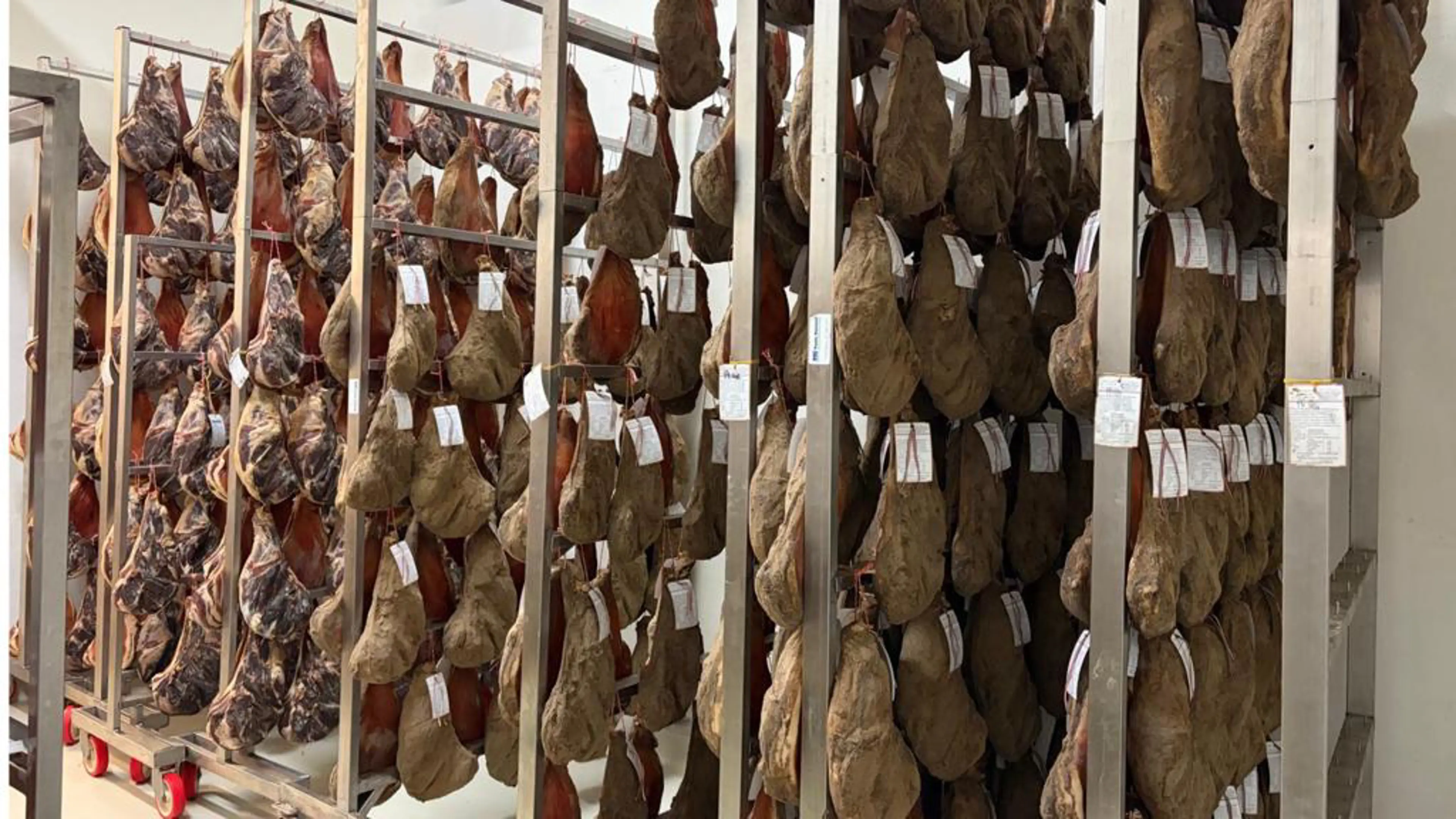
Those who work in catering or food retail sooner or later face the same question: how can you recognize a good Italian cured meats supplier? The market offers countless options, and almost all of them present themselves in the same way, with references to tradition, craftsmanship, and quality. Words that, on their own, say nothing, because no one would write the opposite.
The difference lies elsewhere: in the supply chain, in how the product is processed, how long it actually matures, and what is written on the label. These are verifiable elements, and anyone purchasing professionally has every interest in knowing how to read them. This guide brings together the criteria that make it possible to distinguish a charcuterie producer from a simple reseller, and an authentic product from one designed to cost less.
The first distinction to make concerns who is on the other side. A distributor purchases from third parties and resells: they may have a very extensive catalogue, but they do not control how the products are made or where the raw materials come from. A charcuterie producer makes what they sell, and this changes everything.
When the supplier is also the producer, there is someone who can answer any question in detail: where the meat comes from, how long a ham matures, why one ingredient rather than another is included in a recipe. With an intermediary, these answers, when they arrive, pass through several stages and often stop at what is written on the technical data sheet.
There is also a practical aspect. A producer can adapt formats, assess specific requests, and ensure continuity of the same product over time. A distributor depends on whoever supplies them: if their supplier changes the recipe or stops producing, the problem is passed down the line.
This is the point on which it is worth being most direct, because it is where price differences are almost always explained. A cured meat product can be made in Italy using meat that comes from other European countries: the processing is Italian, but the raw material is not. This is a legitimate and widespread practice, but it is not the same thing.
Those who use exclusively Italian pork usually state it explicitly, because it is a cost they choose to bear. If a supplier does not specify the origin, it is worth asking openly: it is a simple question with a precise answer. It is also worth asking which farms the meat comes from and whether the relationship is stable over time, because consistency in the raw material is what makes the finished product consistent.
Salting, tying, massaging, trimming: these operations can be performed by machine or by hand. The difference is not ideological. Manual salting makes it possible to adjust the amount according to each individual piece, its size, and its shape, which an automated process does not do. The result is greater variation from one piece to another, which in an artisanal product is a characteristic, not a defect.
Asking which stages are performed by hand is a question that quickly separates those who really produce from those who assemble. A producer answers in detail because it is their everyday work.
This is the variable that has the greatest impact on cost and outcome. Aging means keeping a product in controlled environments for months, with weight loss that can reach significant percentages. Every additional month of aging means time, space, and lost weight: this is why it is the first factor to be reduced when targeting a low price.
A quality prosciutto crudo requires at least twelve months. Tuscan salami has different aging times depending on its size. Some products, such as sbriciolona, were created to be eaten young, and short aging is part of their identity. The point is not that longer is always better, but that the stated times are consistent with the type of product and that the supplier can provide them precisely.
The ingredients list is the most honest document a supplier can provide. A traditional cured meat product has a short list: meat, salt, flavorings, and, where applicable, spices specific to the recipe. When the list becomes longer with additives, acidity regulators, flavor enhancers, and milk derivatives, the product is following a different logic.
There are also cured meat products made without added preservatives, where the result is achieved through salt, time, and control of the aging environment. They are more demanding to produce and less tolerant of errors, but the label makes this immediately verifiable. For buyers, reading the ingredients list before looking at the price is the quickest way to understand who they are dealing with.
When a product carries a protected designation, buyers have a guarantee that does not depend on the supplier's word. There is a public specification that establishes ingredients, processing methods, and minimum aging times, as well as an independent body that verifies compliance with those rules. There is no need to simply trust: it can be checked.
This is also a concrete advantage in dealings with the end customer, because it makes it possible to support what is claimed with a verifiable reference. Not all quality cured meat products have a protected designation, and the absence of one is not a negative sign, but where one exists it is worth taking it into account in the assessment.
The choice of format depends on how the product is used and by whom it is handled further down the line. A whole piece requires space and slicing skills, but makes it possible to serve the product when needed and manage yield independently. A vacuum-packed portion is a compromise: it preserves the product's characteristics and reduces the management effort. Sliced product in a tray is designed mainly for direct sale to consumers.
For a serious supplier, large formats are not simply larger packages: they are the way the product is designed to be served. A whole bone-in ham, a three-kilogram finocchiona, or a Tuscan salami weighing more than two kilograms are formats that make sense in a professional setting and are rarely offered to end consumers.
There is one aspect that concerns especially those who work outside Italy. The range of Italian cured meats abroad tends to focus on a few well-known products, which can be found everywhere and for which competition is played out almost exclusively on price.
There are, however, cured meats rooted in regional traditions that rarely travel beyond Italy's borders and make it possible to build a distinctive offering: guanciale, finocchiona, sbriciolona, and cooked cured meats from the Tuscan tradition. These are products that need to be explained to people who do not know them, but for precisely this reason they protect the offering from direct comparison with everyone else's.
A concise outline, useful during an initial conversation with a potential supplier:
Where does the meat you use come from, and how long have you worked with the same farms? Which stages of processing are carried out by hand? What are the minimum aging times for each product? Can I see the complete ingredients list before purchasing? Which products have a protected designation? Which formats are designed for professional use? How often do you change the recipes?
These are questions a producer answers without difficulty, because they simply describe what they do every day. Vague answers, or answers deferred to someone else, are already information.
The information must be stated by the producer and can be verified by asking directly about the origin of the meat. Those who work exclusively with Italian pork tend to indicate it explicitly in product sheets and on the label. In the absence of such information, it is worth asking: it is a question with one clear answer.
No. Some products were created to be eaten young, and prolonged aging would alter their characteristics. The criterion is not the duration itself, but the consistency between the stated times and the type of product, as well as the supplier's ability to specify them precisely.
It means that preservatives such as nitrites and nitrates were not used in the recipe, and that preservation relies on salt, aging time, and control of the processing environment. It is a more demanding process, and the information can always be verified in the ingredients list.
It depends on the buyer's organization. A whole piece requires space and slicing skills but makes it possible to serve the product when needed. A vacuum-packed portion reduces the management effort while preserving the product's characteristics. Many operators use both formats depending on the product.
A producer can answer in detail about origin, processing, and timing, ensure continuity of the same product over time, and assess specific requests regarding formats. An intermediary depends on the choices of whoever supplies them.
Il Poggetto is an artisanal charcuterie producer from Poggio a Caiano, in Tuscany. We produce aged and cooked cured meats using Italian pork, with manual processing and aging in our own facilities. For professional operators, we offer whole formats and vacuum-packed portions, with online quote requests and same-day responses.