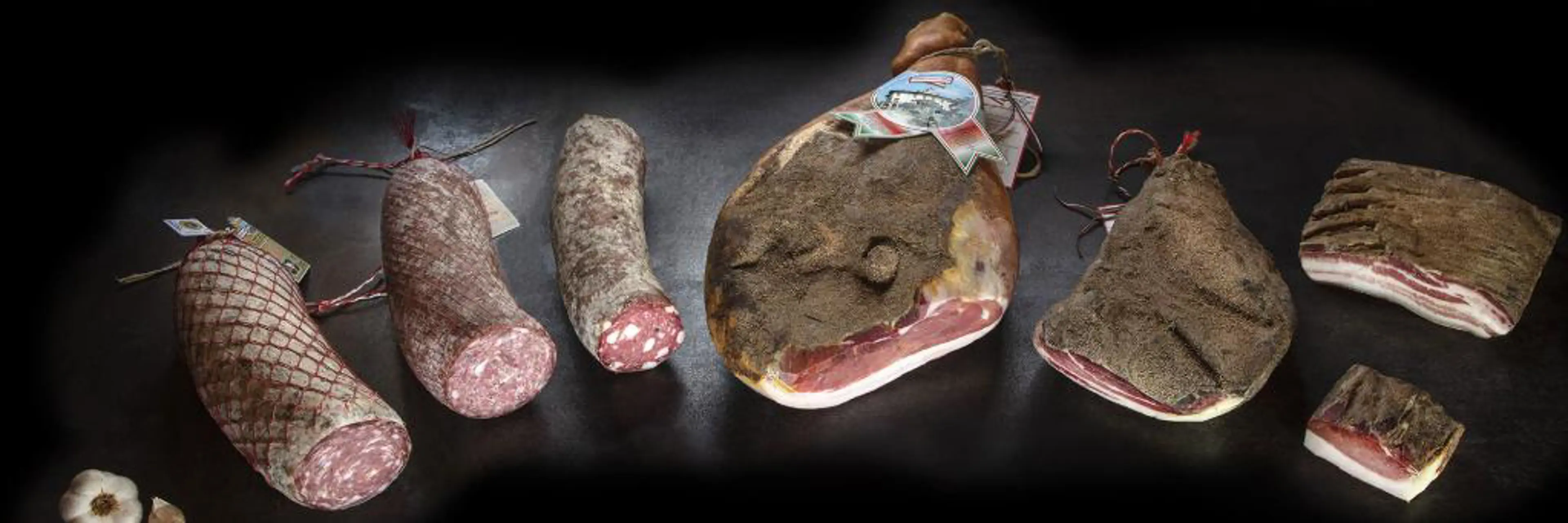
When people talk about Tuscan cured meats, their thoughts naturally turn to the great classics: finocchiona, prosciutto crudo, Tuscan salami. All aged cured meats, leading figures on the charcuterie board and in the best-known tradition.
Less talked about—but just as deeply rooted—is the tradition of cooked cured meats. These are cured meats that, instead of being aged, are cooked in water, melted lard, or using other techniques, often starting from parts of the animal that are not used for aged charcuterie: the head, the tongue, the belly treated with heat. These are cured meats with a peasant history of pure reuse and appreciation of what is available, which today are reclaiming their place on the tables of those seeking the authentic flavors of tradition.
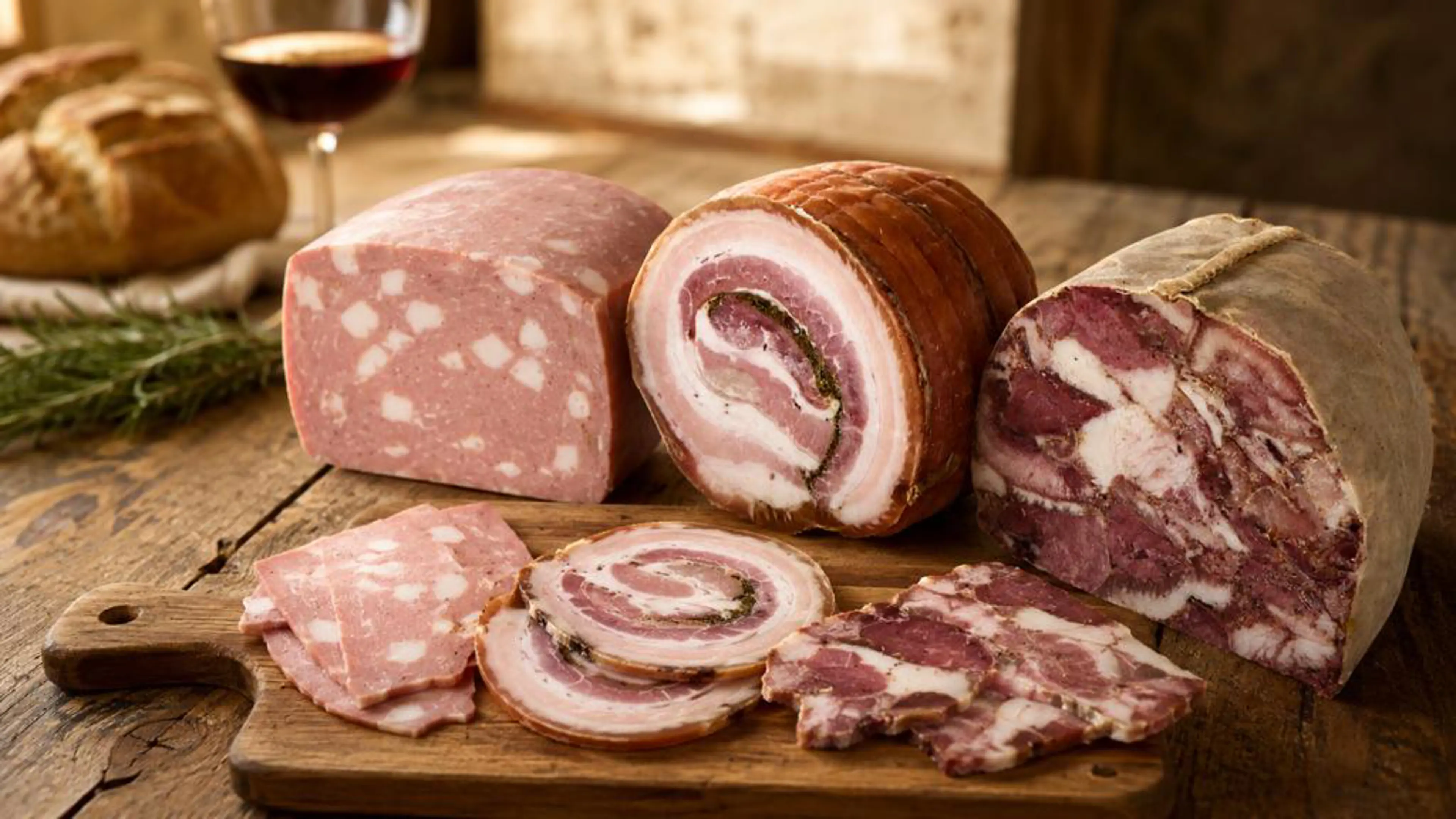
Let’s look at three Tuscan cooked cured meats that deserve to be known: pancetta cooked in lard from the Pistoia Mountains, soprassata**** and Tuscan mortadella.
This cured meat originates in the mountains that divide Tuscany from Emilia-Romagna, particularly in the areas of the Pistoia Mountains: a region that has always had a strong and inventive tradition of preserving pork, shaped by long winters and the peasant economy.
How it is prepared
The pork belly, cut and squared off, is flavored with a mixture of fresh garlic and rosemary. Then comes the step that gives this cured meat its name: cooking in melted lard. The pork lard, melted in a container, becomes the cooking medium in which the pancetta is immersed and slowly cooked for about three hours. It is not boiling in water, nor is it oven cooking: it is a particular technique that allows the fat from the lard to penetrate the cut, enrich it with flavor, and protect it from drying out.
Unlike classic aged pancetta, this product therefore has no subsequent aging phase: after cooking, it is ready to eat. The production process is shorter, but also more delicate—cooking in lard requires constant attention to the temperature, which must never exceed the correct limits in order not to alter the flavor.
The flavor
The result is a cured meat with an extremely soft, almost creamy texture and an intense aroma of garlic and rosemary—the two traditional herbs that blend perfectly with the fat of the belly and the cooking lard. The flavor is full and bold, but without the aggressive saltiness of aged cured meats: here, the richness of the slowly rendered fat takes center stage.
How it is eaten
Pancetta cooked in lard is eaten cold, sliced thinly, or lightly warmed in a pan or in the oven—the gentle heat releases its aroma even more effectively. It is excellent as a rustic appetizer, on Tuscan cured-meat boards (where it adds a soft, fatty element missing from aged cured meats), or accompanied by freshly toasted Tuscan bread.
Soprassata is one of those cured meats that divide Italy by region. Soprassata exists everywhere—Tuscan, Calabrian, Piedmontese—but these are completely different products. The Tuscan version has a distinct identity that is well worth discovering.
How it is prepared
Tuscan soprassata is a cooked cured meat made mainly from pork head and tongue—parts of the animal that, in the peasant tradition, were not wasted but put to good use through specific processing methods. The meat is slowly cooked in water for about three hours, together with aromas that are the hallmark of the Tuscan version: garlic, parsley, and lemon zest. Some recipes add cloves and other spices.
After cooking, the meat is chopped (to a medium-coarse texture), seasoned with salt and pepper, and stuffed into a cloth casing—traditionally sewn by hand. The cured meat is then left to rest so that it can compact and take on its final shape.
The flavor
Tuscan soprassata has a particularly rich flavor: the citrus note of the lemon zest provides unexpected freshness, the parsley adds a herbal note, and the garlic lends depth. The result is a cured meat that tastes of cooked meat, certainly, but is transformed by a blend of aromas that makes it less predictable than simply cooked meat.
The texture is firm but not hard, with visible pieces of meat in the mixture—it is neither a pâté nor a finely minced cured meat, but neither is it coarsely minced. It is a middle ground that allows you to recognize the different textures of the parts used.
How it is eaten
It is always eaten cold, cut into slices that are not too thin (2–3 millimeters are ideal), otherwise it crumbles. It is perfect for Tuscan appetizers, rustic charcuterie boards, seasonal salads, and homemade sandwiches. A classic pairing is with boiled beans dressed with extra-virgin olive oil and red onion, together with the same soprassata cut into cubes—a humble dish from the peasant tradition that is now reclaiming its place on the menus of traditional restaurants.
Mortadella is probably the Italian cured meat most imitated abroad and most misrepresented: when people abroad talk about “mortadella,” they think of the Bolognese version—finely homogenized meat, prominent pistachios, and a uniform pink color. But Tuscany has its own mortadella, with a completely different identity that deserves to be told.
How it is prepared
Tuscan mortadella is a cooked cured meat made from pork (shoulder and pancettone), medium-ground, with clearly visible cubes of fat. The seasoning follows local tradition: granulated garlic, powdered white pepper, and whole peppercorns distributed throughout the mixture. It is slowly cooked in water for about four hours, without rushing—the long cooking time allows the aromas to penetrate evenly and the meat to reach the right consistency.
Unlike Bolognese mortadella, the Tuscan version contains neither pistachios nor the fine grinding that completely homogenizes the mixture. Its structure remains visible when sliced: the white cubes of fat and dark peppercorns can be clearly distinguished, elements that provide both flavor and visual character to the slice.
The flavor
The flavor of Tuscan mortadella is aromatic yet balanced: the pepper emerges with a warm, direct note, while the granulated garlic adds depth without harshness. It is not a cured meat dominated by a single strong flavor, but a combination that comes together on the palate, where the soft fat of the cubes and the savoriness of the cooked meat find balance in the blend of aromas.
The texture is soft but not as uniform as that of the Bolognese version: it has structure, you can feel the slice beneath your teeth, and the cubes of fat melt in the mouth distinctly from the surrounding lean meat.
How it is eaten
Tuscan mortadella is always eaten cold, sliced. The slices can be thin for charcuterie boards and appetizers, or thicker—even half a centimeter—for rustic sandwiches, where the visible structure of the fat cubes gives character to each bite. It pairs well with freshly sliced Tuscan bread, fresh cheeses such as stracchino or ricotta, and vegetables preserved in oil.
In Tuscan cuisine, mortadella also appears in more elaborate preparations: fillings for savory pies, vegetable fillings, and composed salads. Unlike pancetta cooked in lard, which can be warmed to enhance its aroma, mortadella is best served at room temperature—heat would flatten its aromatic complexity.
These three cured meats share a common thread that goes beyond the cooking technique: they are all products born from a peasant culture of avoiding waste. The pig’s head and tongue (soprassata), the belly processed using special techniques (pancetta cooked in lard), the noble and less noble cuts of meat mixed together and transformed by long cooking (mortadella)—these are all practical responses to a world in which every part of the animal had to be put to good use and every preservation method had to work with the means available.
In high-quality aged charcuterie (prosciutto crudo, finocchiona, Tuscan salami), we find the “noble” side of the tradition. In cooked cured meats, we find the everyday, popular side that fed Tuscan families for centuries. Today, these are recipes maintained by only a few producers, often linked to specific areas (such as the Pistoia Mountains for pancetta cooked in lard). Rediscovering them means bringing to the table a less frequently told part of Italian tradition.
Compared with aged cured meats, cooked varieties have slightly different uses that are worth knowing in order to make the most of them:
On a charcuterie board
On a board made up exclusively of aged cured meats, a cooked cured meat adds variety in texture and flavor. Pancetta cooked in lard, in particular, works as a soft, fatty counterpoint to dry cured meats. Soprassata offers an aromatic profile unlike anything else, thanks to the lemon zest. Small amounts are enough—a few slices per person—to enrich a board that would otherwise be monotonous.
As an ingredient in cooking
Tuscan mortadella works in cold or warm preparations: finely chopped to fill savory pies or vegetable fillings, diced in seasonal salads, or layered in thin slices in rustic Tuscan sandwiches. Pancetta cooked in lard can be lightly warmed in the oven to enhance its aroma. Since soprassata is already cooked, it requires no further cooking, but it can be added in cubes to warm salads or legume dishes.
Which bread to serve with it
Unsalted Tuscan bread is always the best choice for accompanying Tuscan cured meats, including cooked varieties. For pancetta cooked in lard, also consider freshly toasted warm crostini: the heat of the bread starts to melt the cured meat slightly, with remarkable results. For soprassata, rustic homemade bread with a substantial crust is the ideal accompaniment.
What is the difference between pancetta cooked in lard and classic aged pancetta?
They are two different products. Classic aged pancetta is simply salted and left to age for months—it is not cooked. Pancetta cooked in lard is seasoned and then slowly cooked in melted fat, without an aging phase. The final result is very different: the aged version is drier and saltier, while the one cooked in lard is soft and aromatic.
Is Tuscan soprassata similar to Calabrian soprassata?
No, they are two completely different products that share only the name. Calabrian soprassata is an aged, spicy cured meat made with lean meat cut with a knife. Tuscan soprassata is a cooked cured meat flavored with lemon and parsley, made mainly from head and tongue. When choosing at the deli counter, it is always best to specify which one you are looking for.
Is Tuscan mortadella the same as Bolognese mortadella?
No, they are two products with the same name but different recipes and characteristics. Bolognese mortadella has finely homogenized meat, added pistachios, a uniform pink color, and a smooth structure. Tuscan mortadella has a coarser grind with clearly visible cubes of fat, contains no pistachios, and has a more pronounced seasoning with pepper and garlic. The differences are clear when sliced: the Bolognese version is uniform, while the Tuscan version has a recognizable structure in every slice.
How should these cured meats be stored once opened?
Like all cooked cured meats, they should be stored in the refrigerator. Once the vacuum-sealed package has been opened, wrap them in kitchen paper or place them in an airtight container and consume them within a few days. Compared with aged cured meats, cooked varieties are more delicate and should not be left at room temperature for extended periods.
At our facility in Poggio a Caiano, Tuscany, we produce pancetta cooked in lard according to the recipe of the Pistoia Mountains, soprassata following the Tuscan tradition with lemon zest, and Tuscan mortadella with visible cubes of fat, flavored with granulated garlic, white pepper, and whole peppercorns. All are made with 100% Italian pork and processed by hand. In the carousel below, you will find our complete range of cooked cured meats.