Poggetto carni
For consumersPersonal purchases

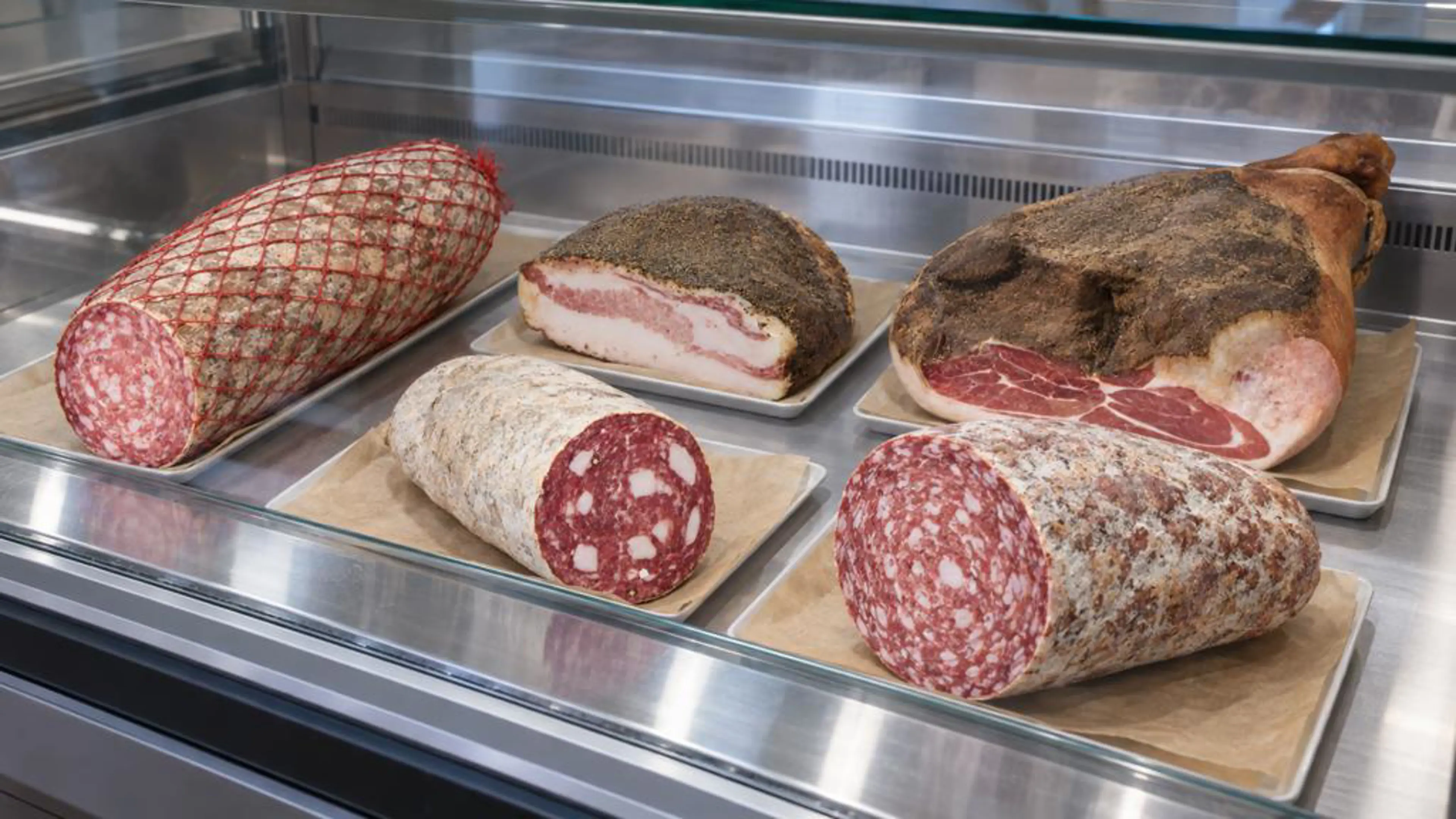
Anyone who runs a delicatessen, a food shop, or a specialty store faces a particular kind of competition: large-scale retail. Supermarkets sell cured meats, often at prices a small shop cannot come close to matching, and customers know it.
The area where you can compete is a different one: products that do not make it into large-scale retail. Not because of quality in the abstract, but for practical reasons: some cured meats have limited production, need to be explained to customers, and do not work on a shelf without someone there to tell their story. These are exactly the products where a shop with someone behind the counter has a structural advantage.
Prosciutto crudo, salami, mortadella: these are the products found everywhere, from discount stores to neighborhood delicatessens. A shop that builds its offering only around these products puts itself in an uncomfortable position, because the customer has an immediate point of comparison, and that comparison concerns price alone.
The same does not happen with a product the customer cannot find elsewhere. When the shop is one of the few places where a certain product is available, price comparison loses importance and the conversation changes: people no longer talk about how much it costs compared with the supermarket, but about what it is and why it is worth trying.
People who do their daily shopping go to the supermarket. Those who enter a specialty shop do so for a different reason: they are looking for something specific, they want advice, or they are preparing for an occasion that deserves special attention. In all three cases, price is not the first consideration.
There is also a growing segment of customers who deliberately choose quality products and have the means to do so. They have often discovered a particular cured meat while traveling, at a restaurant, or on vacation, and are trying to find that exact flavor again. They do not want a similar product; they want that one. This request can only be met with authentic products, and the shop that carries them becomes a trusted point of reference.
When opening a new product line, the temptation is to cover every category. With Italian cured meats, the opposite works better: select a few products and know them well. A counter with five cured meats that the salesperson can describe sells more than a counter with fifteen products that no one can say anything about.
A limited selection also offers practical advantages: less stock rotation to manage, less risk of unsold product, and greater ease in maintaining consistency over time. It also makes it possible to build a clear identity rather than a generic product range.
Saying "Italian cured meats" does not mean much, because every region has a different charcuterie tradition. Building the product range around a specific area is more effective: it provides a story to tell, makes it possible to explain why those products are made in that way, and distinguishes the counter from one offering a generic selection. This applies abroad, where regional origins are waiting to be discovered, but also in Italy: a shop outside Tuscany that stocks authentic Tuscan cured meats offers something its customers cannot find around the corner.
Tuscany, for example, has a distinctive tradition: cured meats with pronounced aromas, characteristic use of wild fennel, and curing periods that prioritize flavor over softness. These are concrete elements that can be explained to a customer and make the choice easier to understand.
How much explanation is needed depends on where the product is sold. Abroad, a customer who reads "finocchiona" on a label often does not know what to expect, so two or three essential pieces of information are needed: what type of cured meat it is, what it tastes like, and how it is eaten. In Italy, the name is familiar, but it is still necessary to explain why that finocchiona is different from the others: who makes it, how it is processed, and how long it is cured. In both cases, one sentence is enough, not a lecture.
The same applies to guanciale, which many customers have heard of because of carbonara but have never bought, or to sbriciolona, the young version of finocchiona, with a completely different texture. A well-written product card does much of the work.
For an unfamiliar product, tasting is the most effective sales tool and has no real alternative. A thin slice cut to order converts more effectively than any description, because it overcomes the only real obstacle: customers do not buy what they do not know whether they will like.
Many customers do not buy a product because they do not know what to do with it. A practical suggestion resolves their hesitation: what to pair it with, which dish to use it in, and how to store it once opened. Here too, little is needed, but it must be concrete.
For a shop that slices to order, the whole piece is the natural choice: it makes it possible to serve the product freshly cut, which is exactly why a customer enters a delicatessen instead of picking up a package at the supermarket. However, it requires space, sufficient turnover, and the ability to manage a piece once it has been started.
A vacuum-packed portion is a more manageable alternative, useful for slower-moving products or for testing a new item before committing to a whole piece. Pre-sliced packages, on the other hand, make sense for self-service, alongside the staffed counter, for customers in a hurry.
Many shops use a combination: whole pieces for the best-selling products, where slicing to order makes a difference, and portions for the rest of the product range.
A sensible initial selection starts with a familiar product that reassures customers, such as prosciutto crudo, alongside two or three specialties that are difficult to find elsewhere. Familiar products bring people to the counter; specialties give them a reason to come back.
After a few weeks, the sales data tells the rest of the story: which products turn over quickly, which need to be explained every time, and which work only for certain occasions. The product range should be adjusted accordingly, not according to a forecast made at the beginning.
Four or five items are enough to build a recognizable offering. A limited product range is easier to learn, describe, and manage, and reduces the risk of unsold product during the initial phase.
It depends on turnover. Whole pieces make sense for the best-selling products, where slicing to order is part of the service. Vacuum-packed portions are better suited to slower-moving items and for testing a new product before committing to a large piece.
With three pieces of information: what type of cured meat it is, what it tastes like, and how it is used. A clear product card covers much of the need, but for lesser-known products, tasting remains the most effective tool.
They share the same base—pork and fennel seeds—but have different curing periods and distinct identities. Finocchiona is protected by the PGI designation and is known throughout Italy: it is cured for longer and has a firm texture. Sbriciolona is eaten young, after just a few days of curing, and is soft enough to crumble when sliced, which is where its name comes from. It is a typically Tuscan specialty precisely because of this characteristic.
Cured meats have different storage requirements from fresh products. The specific guidelines vary depending on the product and are always indicated on the label: it is worth checking them with the supplier before finalizing the setup.
Il Poggetto is an artisanal charcuterie producer based in the Medici municipality of Poggio a Caiano, in Tuscany. We produce cured and cooked meats using Italian pork, with manual processing and curing in our own facilities. For shops and delicatessens, we offer whole pieces and vacuum-packed portions, with online quotation requests and same-day replies.


